


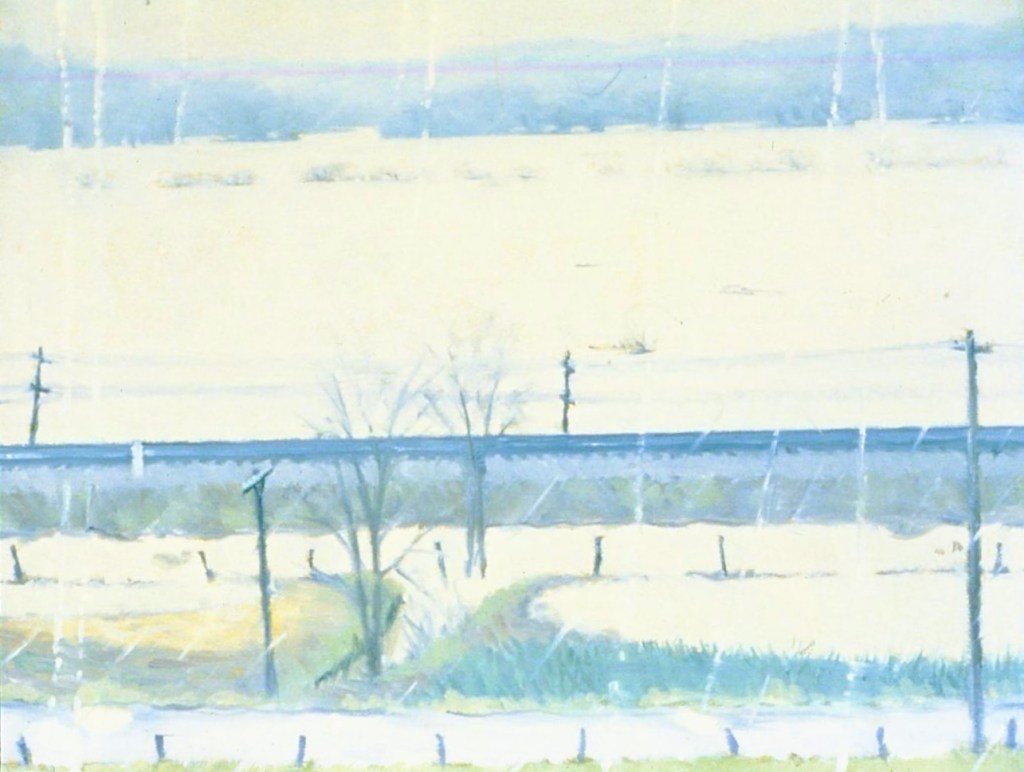
Looking out over the retreating floodwaters of the Ohio River near Fort Thomas, Kentucky, an aspiring painter named Harlan Hubbard (1900-1988) paused to pull a notebook from his pocket. With a dull pencil he scribbled the date, March 21, 1933, and recorded,
“I have been affected by this rise of water. […] I need a flood in my soul, to carry off all the old drift and the flimsy habits that have extended down to the water’s edge. […] If it does not come, the river will become stagnant, filled with growth and mud.”
Floodwaters on the Ohio, Harlan Hubbard, 1930s, oil on board, slide in Hanover College Collection, ©Florence F. Caddell
At 33 years old, Hubbard worried that no creative flood was coming. He had been living with his mother, unmarried and unassured, working as a contractor to make ends meet. He had little time for his creative pursuits or for his greatest passion, rambling along his native landscapes and waterways.

It is an unfamiliar glimpse of a figure who, nearly a century later, holds an honored place in Kentucky arts and letters as a maverick and inspiration. His breakout book, Shantyboat (1953), has become an oft-cited influence on contemporary river explorers. Hubbard’s later writings, chronicling his unique second act with his wife, Anna, stand as a primer for sustainable living amid climate crisis.
And his artwork–stylistically varied and brimming with experimentation–remains a valuable reminder of a rapidly disappearing Kentucky landscape and culture.
How did such a radical transformation occur? What were the forces that shaped and molded Harlan Hubbard from awkward and overlooked to fulfilled and revered?
Harlan Hubbard at the McAlpine Lock & Dam, Louisville, Kentucky, 1948, Courtesy of the Behringer-Crawford Museum Collection
 DRIFTWOOD