

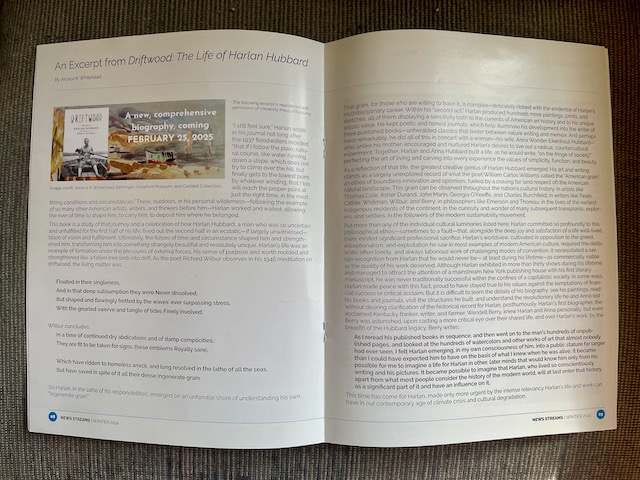
If you received the Kentucky Waterways Alliance‘s Winter 2024 NewsStreams magazine, you’ll have seen the generous excerpt from Driftwood: The Life of Harlan Hubbard in its pages (8-9, to be precise). If you don’t already know about KWA and the amazing work they do in our region, I’d encourage you to learn more!
The excerpt in the magazine comes from the prologue to the upcoming biography. On what would have been Harlan’s 125th birthday, I thought I would share the excerpt here, too.
As a reminder, you can pre-order Driftwood from University Press of Kentucky’s website, or you can join me for a book talk and signing sometime in 2025.
And, if you can, please join us at the Filson Historical Society for the book launch on 2/25/2025, where you will also get to hear the premiere of Danial Gilliam’s “Piano Trio No. 2: Payne Hollow.” (You can support the commission for that piece of music, here.)

The following excerpt is reproduced with permission of University Press of Kentucky:
“I still feel sure,” Harlan wrote in his journal not long after the 1937 floodwaters receded, “that if I follow the plain, natural course, like water running down a slope, which does not try to climb over the hill, but finally gets to the lowest point, by whatever winding, that I too will reach the proper point at just the right time, in the most fitting conditions and circumstances.” There, outdoors, in his personal wilderness—following the example of so many other American artists, writers, and thinkers before him—Harlan worked and waited, allowing the river of time to shape him, to carry him, to deposit him where he belonged.
This book is a study of that journey and a celebration of how Harlan Hubbard, a man who was so uncertain and unfulfilled for the first half of his life, lived out the second half in an ecstatic—if largely unwitnessed— blaze of vision and fulfillment. Ultimately, the forces of time and circumstance shaped him and strengthened him, transforming him into something strangely beautiful and resolutely unique. Harlan’s life was an example of formation under the pressures of external forces, his sense of purpose and worth molded and strengthened like a fallen tree limb into drift. As the poet Richard Wilbur observes in his 1948 meditation on driftwood, the living matter was
Floated in their singleness,
And in that deep subsumption they were Never dissolved;
But shaped and flowingly fretted by the waves’ Ever surpassing stress,
With the gnarled swerve and tangle of tides Finely involved.
Wilbur concludes,
In a time of continued dry abdications And of damp complicities,
They are fit to be taken for signs, these emblems Royally sane,
Which have ridden to homeless wreck, and long resolved In the lathe of all the seas,
But have saved in spite of it all their dense Ingenerate grain.
So Harlan, in the lathe of his responsibilities, emerged on an unfamiliar shore of understanding his own, “ingenerate grain.”
That grain, for those who are willing to trace it, is complex—delicately ribbed with the evidence of Harlan’s multidisciplinary career. Within his “second act,” Harlan produced hundreds more paintings, prints, and sketches, all of them displaying a sensitivity both to the currents of
American art history and to his unique artistic voice. He kept poetic and honest journals, which help illuminate his development into the writer of three published books—unheralded classics that teeter between nature writing and memoir. And perhaps most remarkably, he did all of this in concert with a woman—his wife, Anna Wonder Eikenhout Hubbard— who, unlike his mother, encouraged and nurtured Harlan’s desires to live out a radical, countercultural experiment. Together, Harlan and Anna Hubbard built a life, as he would write, “on the fringe of society,” perfecting the art of living and carving into every experience the values of simplicity, function, and beauty.
As a reflection of that life, the greatest creative genius of Harlan Hubbard emerged. His art and writing stands as a largely unexplored record of what the poet William Carlos Williams called the “American grain”: an ethos of boundless innovation and optimism, fueled by a craving for (and respect of) the American natural landscape. This grain can be observed throughout the nation’s cultural history: in artists like Thomas Cole, Asher Durand, John Marin, Georgia O’Keeffe, and Charles Burchfield; in writers like Twain, Cather, Whitman, Wilbur, and Berry; in philosophers like Emerson and Thoreau; in the lives of the earliest Indigenous residents of the continent; in the curiosity and wonder of many subsequent transplants, explorers, and settlers; in the followers of the modern sustainability movement.
But more than any of the individual cultural luminaries listed here, Harlan committed so profoundly to this philosophical ethos—sometimes to a fault—that, alongside the deep joy and satisfaction of a life well-lived, there existed significant professional sacrifice. Harlan’s worldview, cultivated in opposition to the greed, exceptionalism, and exploitation he saw in most examples of modern American culture, required the deliberate, often lonely, and always laborious work of challenging modes of convention. It necessitated a certain recognition from Harlan that he would never be— at least during his lifetime—as commercially viable as the quality of his work deserved. Although Harlan exhibited in more than thirty shows during his lifetime and managed to attract the attention of a mainstream New York publishing house with his first literary manuscript, he was never traditionally successful within the confines of a capitalistic society. In some ways, Harlan made peace with this fact, proud to have stayed true to his values against the temptations of financial success or critical acclaim. But it is difficult to learn the details of his biography, see his paintings, read his books and journals, visit the structures he built, and understand the revolutionary life he and Anna led without desiring clarification of the historical record for Harlan, posthumously. Harlan’s first biographer, the acclaimed Kentucky thinker, writer, and farmer, Wendell Berry, knew Harlan and Anna personally, but even Berry was astonished, upon casting a more critical eye over their shared life, and over Harlan’s work, by the breadth of the Hubbard legacy. Berry writes:
As I reread his published books in sequence, and then went on to the man’s hundreds of unpublished pages, and looked at the hundreds of watercolors and other works of art that almost nobody had ever seen, I felt Harlan emerging, in my own consciousness of him, into a public stature far larger than I could have expected him to have on the basis of what I knew when he was alive. It became possible for me to imagine a life for Harlan in other, later minds that would know him only from his writing and his pictures. It became possible to imagine that Harlan, who lived so conscientiously apart from what most people consider the history of the modern world, will at last enter that history as a significant part of it and have an influence on it.
This time has come for Harlan, made only more urgent by the intense relevancy Harlan’s life and work can have in our contemporary age of climate crisis and cultural degradation.
 DRIFTWOOD
Leave a comment